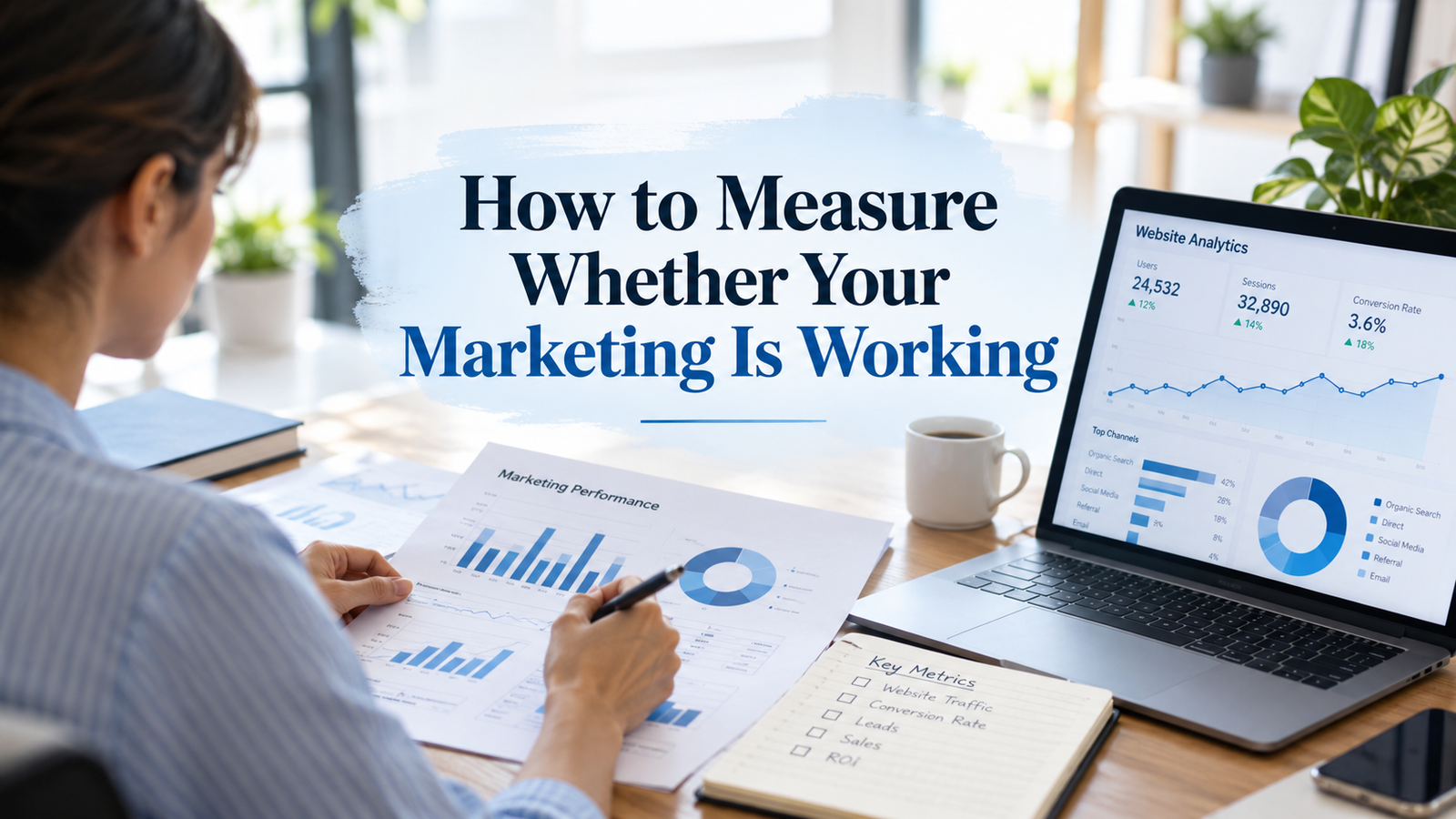
Marketing is one of the most important parts of any business, but simply spending money on advertisements, social media, content, or promotions does not guarantee good results. A business owner needs to know whether these efforts are actually helping the business grow.
Many small business owners make the mistake of judging marketing only by likes, views, or followers. These numbers can be useful, but they do not always show whether people are becoming customers. Effective marketing measurement looks at the complete picture. It connects marketing activity with customer interest, sales, inquiries, and long term business growth.
Learning how to measure whether your marketing is working can help you avoid wasting money and focus your time on strategies that produce real results.
Start With a Clear Marketing Goal
Before measuring marketing performance, you need to know what you want your marketing to achieve.
Different marketing campaigns can have different goals. One campaign may be designed to increase website traffic, while another may focus on generating leads or increasing sales.
Your marketing goal should be clear and measurable.
For example, instead of saying, “I want more customers,” a stronger goal may be, “I want to generate 50 qualified inquiries from my website this month.”
Another goal could be, “I want to increase online sales by 15 percent during the next three months.”
Clear goals make marketing easier to measure because you know exactly what result you are looking for.
Track Where Your Customers Come From
One of the easiest ways to understand marketing performance is to identify where your customers are coming from.
A customer may discover your business through Google search, Facebook, Instagram, YouTube, email, a referral, or a local advertisement.
If you do not track these sources, you may continue spending money on a marketing channel that produces very little business.
You can ask new customers a simple question such as, “How did you hear about us?”
Online businesses can also use website analytics tools to see which traffic sources bring visitors to the website.
When you know where customers are coming from, you can invest more time and money in the channels that work best.
Measure Website Traffic
Website traffic is one of the basic marketing metrics for businesses that use digital marketing.
Traffic tells you how many people visit your website during a certain period.
However, traffic alone does not show whether marketing is successful.
Imagine that your website receives 20,000 visitors in one month but only five people contact your business. In this case, traffic is high, but the website may not be attracting the right audience or converting visitors effectively.
It is better to study both traffic and visitor behavior.
Look at how many people visit the website, which pages they view, how long they stay, and what actions they take.
These details can help you understand whether your marketing is bringing useful visitors or simply increasing numbers.
Monitor Conversion Rate
Conversion rate is one of the most important ways to measure marketing effectiveness.
A conversion happens when someone completes an action that is important to your business.
This action could be making a purchase, filling out a contact form, booking an appointment, joining an email list, or requesting a quotation.
You can calculate conversion rate by dividing the number of conversions by the number of visitors and multiplying the result by 100.
For example, if 1,000 people visit your website and 50 make a purchase, your conversion rate is 5 percent.
A higher conversion rate usually means that your marketing message and offer are connecting well with the audience.
Track Leads and Inquiries
For many businesses, marketing does not produce an immediate sale.
Instead, marketing generates leads.
A lead is a person who shows interest in your product or service and may become a customer later.
Examples of leads include people who call your business, send a message, fill out a form, request a quotation, or book a consultation.
Track how many leads come from each marketing channel.
If Facebook produces 100 leads while another channel produces only 10, this information can help you compare performance.
You should also look at lead quality.
A marketing channel that produces fewer but more serious customers may be more valuable than one that produces many weak inquiries.
Measure Cost Per Lead
Cost per lead helps you understand how much money you spend to generate one potential customer.
The formula is simple.
Divide your total marketing cost by the number of leads generated.
For example, if you spend $500 on advertising and receive 50 leads, your cost per lead is $10.
This number can help you compare different marketing campaigns.
If one campaign costs $10 per lead and another costs $35 per lead, the first campaign may appear more efficient.
However, always compare cost with lead quality because cheaper leads are not always better.
Measure Customer Acquisition Cost
Customer acquisition cost shows how much money it costs your business to gain one new customer.
This is slightly different from cost per lead because not every lead becomes a paying customer.
To calculate customer acquisition cost, divide your marketing and sales expenses by the number of new customers gained during the same period.
For example, if you spend $2,000 and gain 40 new customers, your customer acquisition cost is $50.
Understanding this number is important because it helps you judge whether your marketing spending is financially reasonable.
If acquiring a customer costs more than the profit you expect to earn from that customer, your marketing strategy may need improvement.
Look at Marketing Return on Investment
Return on investment helps you compare the money spent on marketing with the money generated from it.
This is often called marketing ROI.
Suppose you spend $1,000 on a campaign and it generates $4,000 in revenue.
The campaign has produced more revenue than it cost.
However, revenue is not the same as profit, so it is useful to consider your product costs, operating costs, and other expenses when evaluating the true value of a campaign.
Marketing ROI can help you understand which campaigns deserve more investment and which ones may need to be changed.
Watch Your Sales Trends
Sales numbers can reveal whether marketing is having a real impact.
Compare sales before, during, and after a marketing campaign.
You can also compare weekly, monthly, or yearly performance.
For example, if your average monthly sales were $10,000 before a campaign and increased to $14,000 during the campaign, marketing may have contributed to the improvement.
However, remember that sales can change for many reasons.
Seasonal demand, pricing changes, new competitors, holidays, and economic conditions can all affect sales.
That is why marketing performance should not be judged by one number alone.
Track Email Marketing Results
If your business uses email marketing, several useful metrics can help you measure performance.
Open rate shows how many people open your emails.
Click rate shows how many people click a link inside the email.
Conversion rate shows how many readers complete the desired action after clicking.
You should also watch unsubscribe rates.
If many people are leaving your email list, your content may not be matching their expectations.
Email marketing works best when you focus on useful content rather than sending constant promotions.
Measure Social Media Results Carefully
Social media platforms provide many numbers such as likes, comments, shares, views, followers, and reach.
These numbers can help you understand audience engagement, but they should not be treated as the final measure of success.
For example, a post may receive thousands of likes but produce no sales.
Another post may receive only 100 views but generate several serious customer inquiries.
For this reason, connect social media activity with business results.
Look at website visits, inquiries, email signups, bookings, and sales that come from social media.
This gives you a more accurate picture of marketing performance.
Study Customer Engagement
Customer engagement shows how people interact with your marketing content.
On a website, engagement may include reading articles, visiting multiple pages, watching videos, or using contact forms.
On social media, engagement may include comments, shares, saves, and direct messages.
Strong engagement often means that people find your content useful or interesting.
However, engagement should support a wider business goal.
Do not chase engagement simply because the numbers look impressive.
The real question is whether engagement is helping people move closer to becoming customers.
Compare Different Marketing Channels
Businesses often use several marketing channels at the same time.
You may use search engines, social media, email marketing, referrals, local advertising, and paid campaigns.
Measure these channels separately whenever possible.
You might discover that Google search brings customers who are ready to buy, while social media brings people who are still learning about your business.
Both channels can be useful, but they serve different purposes.
Comparing marketing channels helps you understand where your audience is most active and where your budget produces stronger results.
Measure Customer Retention
Marketing should not only attract new customers. It should also help existing customers return.
Customer retention shows how well your business keeps customers over time.
Repeat customers can be extremely valuable because they already know and trust your business.
Track how many customers purchase again after their first order.
You can also study repeat purchase rate, subscription renewals, loyalty program activity, or returning website visitors.
If your marketing brings new customers but very few return, you may need to improve the customer experience or follow up communication.
Listen to Customer Feedback
Numbers are important, but customer feedback can explain why those numbers are changing.
Ask customers what they liked, what confused them, and what influenced their buying decision.
You can collect feedback through surveys, reviews, email responses, phone conversations, or social media comments.
Sometimes customers will reveal useful information that analytics cannot show.
For example, customers may say that they discovered your business through an educational article, trusted you because of online reviews, or decided to buy after watching a product video.
This information can help you improve future marketing.
Use Simple Marketing Reports
You do not need a complicated reporting system to measure marketing.
A simple monthly report can be enough for many small businesses.
Track important numbers such as website traffic, leads, conversions, sales, advertising cost, customer acquisition cost, and marketing revenue.
Then compare these numbers with the previous month.
Over time, patterns will become easier to see.
You may notice that some campaigns perform better during certain seasons or that one marketing channel consistently produces stronger results.
Regular reporting helps you make decisions based on evidence rather than guesswork.
Avoid Measuring Too Many Metrics
Marketing platforms can provide hundreds of different statistics.
Trying to track everything can make marketing more confusing.
Focus on the numbers that are connected to your business goals.
If your goal is sales, track sales, conversion rate, customer acquisition cost, and return on investment.
If your goal is brand awareness, you may focus more on reach, website visits, direct searches, and audience growth.
Choose a small group of meaningful marketing metrics and review them regularly.
This approach keeps your marketing analysis simple and useful.
Give Marketing Enough Time
Not every marketing strategy produces immediate results.
Paid advertising may generate traffic quickly, while content marketing and search engine optimization may take longer to build momentum.
Avoid stopping a strategy too early simply because results are not immediate.
At the same time, do not continue spending money forever if the numbers show no improvement.
Set a reasonable testing period and compare results after enough data has been collected.
Good marketing measurement requires patience as well as discipline.
Test and Improve Your Marketing
Marketing should be treated as an ongoing process.
You can test different headlines, advertisements, images, offers, landing pages, email subjects, and calls to action.
Change one major element at a time so you can understand what caused the improvement.
For example, you may test two versions of a landing page.
If one version produces more customer inquiries, you can use the better version and continue testing other improvements.
Small changes can sometimes create significant improvements in marketing performance.
Focus on Long Term Business Growth
Successful marketing should eventually create stronger business results.
Look beyond individual campaigns and study how the business is changing over time.
Are more people discovering your brand?
Are inquiries increasing?
Are customers returning?
Is revenue growing?
Is your cost of acquiring customers becoming more efficient?
These questions help you understand whether your marketing system is becoming stronger.
A successful marketing strategy is not simply one advertisement that performs well. It is a repeatable process that consistently attracts the right customers and supports business growth.
Final Thoughts
Measuring whether your marketing is working does not need to be complicated. Start with clear goals, track where customers come from, measure conversions, calculate important costs, and connect marketing activity with real business results.
Do not depend only on likes, views, or followers. These numbers can be useful, but they should support larger goals such as leads, customers, sales, and long term growth.
Review your results regularly and compare different marketing channels. Keep the strategies that produce useful results and improve the ones that are underperforming.
When marketing decisions are based on real data instead of assumptions, it becomes much easier to spend your time and money wisely. Over time, this approach can help you build a more efficient marketing system and a stronger business.