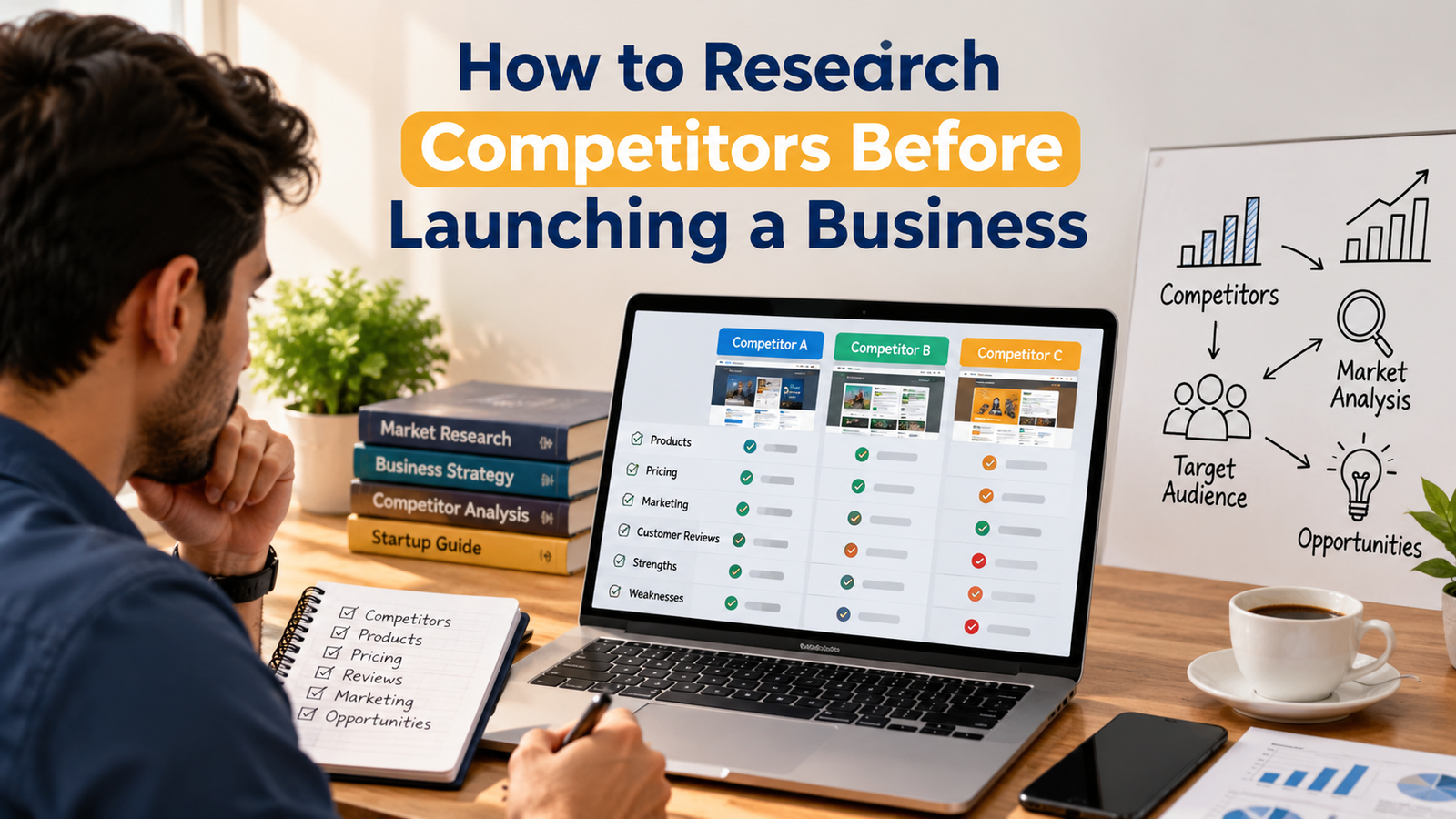
Starting a business is exciting, but launching without understanding the competition can create unnecessary risk. A good business idea may look promising at first, yet the market may already have strong competitors serving the same customers. This does not mean you should abandon your idea. It simply means you need to understand the market before investing your money, time, and energy.
Competitor research helps you see what other businesses are doing, what customers expect, where gaps exist, and how you can position your business more clearly. I have found that the purpose of competitor research is not to copy successful companies. The real purpose is to learn from the market and make better decisions.
If you know how to research competitors before launching a business, you can avoid many common mistakes and build a stronger foundation from the beginning.
What Is Competitor Research?
Competitor research is the process of studying businesses that sell similar products or services to the same type of customer.
It usually involves looking at their products, pricing, marketing, customer service, website, social media, reviews, branding, and overall business approach.
The goal is to understand how the market currently works.
For example, if you want to open an online clothing store, you should study other online clothing businesses that serve a similar audience. You may look at their prices, product range, delivery policies, website design, social media content, and customer reviews.
This information can help you identify what customers already like and what they still find frustrating.
Why Competitor Research Matters Before Launch
Many people become emotionally attached to a business idea. They may believe their idea is unique or automatically better than existing options.
The market may tell a different story.
Competitor research gives you a more realistic picture.
It helps you answer important questions such as:
Who are the main businesses already serving this market?
What do customers like about them?
What problems do customers complain about?
How much are customers currently paying?
Which products or services appear most popular?
How are competitors attracting customers?
What opportunities are still available?
These questions can influence almost every part of your business plan.
Start by Identifying Your Direct Competitors
Your first step is to identify businesses that are very similar to the one you want to launch.
These are known as direct competitors.
A direct competitor usually sells a similar product or service to a similar customer.
Suppose you want to start a meal delivery service for office workers. Other companies delivering ready made meals to office workers would be your direct competitors.
A local restaurant may also deliver food, but it may serve a broader audience. That could make it an indirect competitor rather than a direct one.
You can find direct competitors through Google searches, social media, online marketplaces, local business directories, and recommendations from people in your target market.
Try searching the exact words that a customer might use.
For example, if you want to launch a home cleaning service, you might search phrases such as:
Home cleaning service near me
Affordable house cleaning
Professional home cleaners
Weekly cleaning service
These searches can reveal which businesses customers are most likely to discover.
Study Indirect Competitors Too
Indirect competitors are also important.
They may not offer exactly the same product, but they solve the same customer problem.
For example, a coffee shop does not only compete with other coffee shops. It may also compete with convenience stores, vending machines, home coffee makers, and delivery services.
If a customer has several ways to solve the same problem, all of those alternatives matter.
Studying indirect competitors can help you understand the wider market.
It can also reveal opportunities that direct competitor research may miss.
Visit Competitor Websites Carefully
A competitor website can tell you a great deal about the business.
Spend time exploring it like a potential customer.
Look at the homepage first.
Ask yourself what message the business is communicating. Is the business focused on affordability, quality, convenience, luxury, speed, or something else?
Then explore its products or services.
Pay attention to how they are presented.
Look at product descriptions, images, pricing, guarantees, customer testimonials, frequently asked questions, and calls to action.
You should also study how easy or difficult the website is to use.
A confusing website may reveal an opportunity for your future business to create a better customer experience.
Compare Competitor Pricing
Price is one of the most useful areas to research before launching a business.
You should understand the normal price range in your market.
Create a simple table or notebook where you record competitor prices.
Do not look at price alone.
Try to understand what customers receive for that price.
One competitor may charge more because it includes free delivery. Another may charge less but provide fewer features. A third may offer a subscription plan that reduces the average cost.
Your goal is to understand the relationship between price and value.
This can help you decide whether your business should compete through lower prices, better service, higher quality, convenience, or another advantage.
Read Customer Reviews
Customer reviews are one of the best sources of competitor research.
They show you what real customers are saying about businesses in your market.
You can find reviews on Google, Facebook, online marketplaces, industry websites, app stores, and other platforms.
Do not only read positive reviews.
Negative reviews are often even more useful.
Look for repeated complaints.
Customers may mention slow delivery, poor communication, confusing instructions, low product quality, limited choices, difficult returns, or unexpected charges.
If the same complaint appears again and again, it may represent a real market opportunity.
Positive reviews are useful too.
They show you what customers value.
If many customers praise fast delivery or friendly service, those qualities may be important expectations in the market.
Study Competitor Social Media
Social media can reveal how competitors communicate with their audience.
Visit their profiles on platforms such as Facebook, Instagram, TikTok, LinkedIn, YouTube, or other relevant channels.
Pay attention to the type of content they publish.
Do they share educational content?
Do they focus on promotions?
Do they use videos?
Do they show behind the scenes content?
Do they answer customer questions?
Look at which posts receive the most engagement.
This may help you understand what interests the audience.
You can also study how often the company posts and how quickly it responds to comments.
Do not copy their content. Use your observations to understand what kind of communication works in the market.
Understand Their Marketing Message
Every strong business usually has a main message.
Some businesses focus on low prices.
Some focus on premium quality.
Some focus on speed.
Others focus on simplicity, personal service, sustainability, or trust.
Try to identify the main promise each competitor makes.
Then ask yourself an important question:
Can my business offer a different and meaningful reason for customers to choose it?
This is where competitor research becomes useful for positioning.
You do not need to be completely different from every competitor. You simply need to give customers a clear reason to consider your business.
Compare Products and Services
Create a simple comparison of what each competitor offers.
For example, if you want to launch a digital marketing agency, you might compare services such as website design, social media management, search engine optimization, content writing, advertising, and email marketing.
If several competitors offer the same services, look at how they package them.
Some may sell individual services. Others may offer monthly plans.
Studying these differences can help you design your own offer more carefully.
You may discover that customers want a simpler package or a more flexible option.
Look for Gaps in the Market
One of the main reasons to research competitors is to identify gaps.
A market gap is an area where customer needs are not being fully met.
A gap may involve price, quality, service, location, product features, customer support, convenience, or a specific type of customer.
For example, you may discover that most competitors offer premium products at high prices, while few serve budget conscious customers.
Or you may find that competitors sell excellent products but provide poor customer support.
These gaps can become business opportunities.
However, not every gap is worth pursuing.
Sometimes a service is missing because customers do not want it.
That is why competitor research should be combined with customer research.
Study Their Strengths
It is easy to focus only on competitor weaknesses, but their strengths are equally important.
If a competitor has thousands of positive reviews, strong brand recognition, efficient delivery, or loyal customers, you should respect those advantages.
Understanding competitor strengths can help you avoid unrealistic assumptions.
It can also help you decide where not to compete directly.
For example, a small new business may struggle to beat a large company on price.
Instead, it may compete through personal service, specialization, local knowledge, or flexibility.
Study Their Weaknesses
Weaknesses can reveal opportunities.
A competitor may have outdated branding, slow delivery, poor communication, limited payment options, or an inconvenient ordering process.
However, avoid assuming that every weakness is easy to fix.
Sometimes a problem exists because solving it would be expensive.
Try to understand why the weakness exists.
This will help you decide whether your business can realistically do better.
Learn From Their Advertising
Competitor advertising can reveal what products and messages they consider important.
You may notice ads on Google, Facebook, Instagram, YouTube, or other platforms.
Pay attention to the language they use.
What problem are they trying to solve?
What benefit are they promoting?
What offer are they making?
What action are they asking the customer to take?
Repeated advertising themes can give you clues about what attracts buyers.
Again, the goal is not to copy.
The goal is to understand how businesses in the market communicate value.
Visit Competitors in Person When Possible
If competitors have physical locations, visiting them can provide useful information.
Observe the customer experience.
Look at the layout, service quality, waiting time, product presentation, cleanliness, staff behavior, and overall atmosphere.
Try to experience the business like a normal customer.
You can learn things in person that may not be obvious online.
For example, a competitor may have a strong website but poor in store service.
Or the opposite may be true.
Talk to Potential Customers
Competitor research becomes much stronger when you speak with real customers.
Ask people in your target market which businesses they currently use and why.
Find out what they like.
Ask what frustrates them.
Ask what would make them consider trying another company.
Avoid leading questions.
Instead of asking, “Would you buy from a cheaper company?” ask, “What matters most when choosing this type of business?”
Open questions often produce better information.
Create a Simple Competitor Comparison
You do not need complicated software to organize competitor research.
A spreadsheet can be enough.
Create columns for information such as:
Business name
Products or services
Target customer
Price range
Main selling point
Website quality
Social media activity
Customer reviews
Delivery options
Customer support
Strengths
Weaknesses
Possible opportunities
This simple comparison can help you see patterns more clearly.
Avoid Copying Competitors
Competitor research becomes dangerous when entrepreneurs begin copying everything another business does.
If you copy the same products, branding, pricing, marketing message, and customer experience, you may create a business that has no clear identity.
Research should give you insight, not imitation.
Ask what you can learn from competitors while still building something that reflects your own business idea and customer needs.
Do Not Assume the Biggest Competitor Is the Only One That Matters
Large companies are easy to notice, but smaller competitors may teach you more.
Small businesses often serve specific customer groups more closely.
They may also test new ideas faster.
Study a mixture of large, medium, and small businesses.
This gives you a more complete picture of the market.
Keep Your Research Updated
Competitor research should not end when your business launches.
Markets change.
Competitors introduce new products, change prices, improve websites, and adopt new marketing strategies.
Customer expectations also change.
Set aside time every few months to review the market again.
You do not need to watch every competitor every day.
A simple regular review can keep you informed.
Use Competitor Research to Improve Your Business Plan
The final purpose of competitor research is better decision making.
After completing your research, review your business idea.
Ask yourself:
Is there real demand?
Can I offer something customers value?
Is my pricing realistic?
What weaknesses can I avoid?
What strengths do successful competitors share?
How can I make my offer clear?
Your answers can influence your products, pricing, marketing, customer service, branding, and launch strategy.
Common Mistakes in Competitor Research
One common mistake is studying only successful companies.
Businesses that struggle can also teach valuable lessons.
Another mistake is looking only at prices.
Competition involves much more than price.
Customer service, convenience, trust, quality, branding, and communication all matter.
Some entrepreneurs also collect too much information without using it.
Research becomes valuable only when it improves your decisions.
Final Thoughts
Learning how to research competitors before launching a business can help you enter the market with more knowledge and fewer assumptions.
Competitor research shows you how existing businesses serve customers, what they charge, how they market themselves, what customers appreciate, and where problems still exist.
The goal is not to become obsessed with competitors.
Your main focus should always remain on the customer.
Competitors simply provide useful evidence about how the market currently operates.
By studying direct and indirect competitors, reading reviews, comparing prices, analyzing products, observing marketing, and speaking with potential customers, you can build a clearer picture of your business opportunity.
A successful launch usually begins with preparation. The more you understand the market before spending money, the easier it becomes to make thoughtful decisions and create a business that offers real value.