
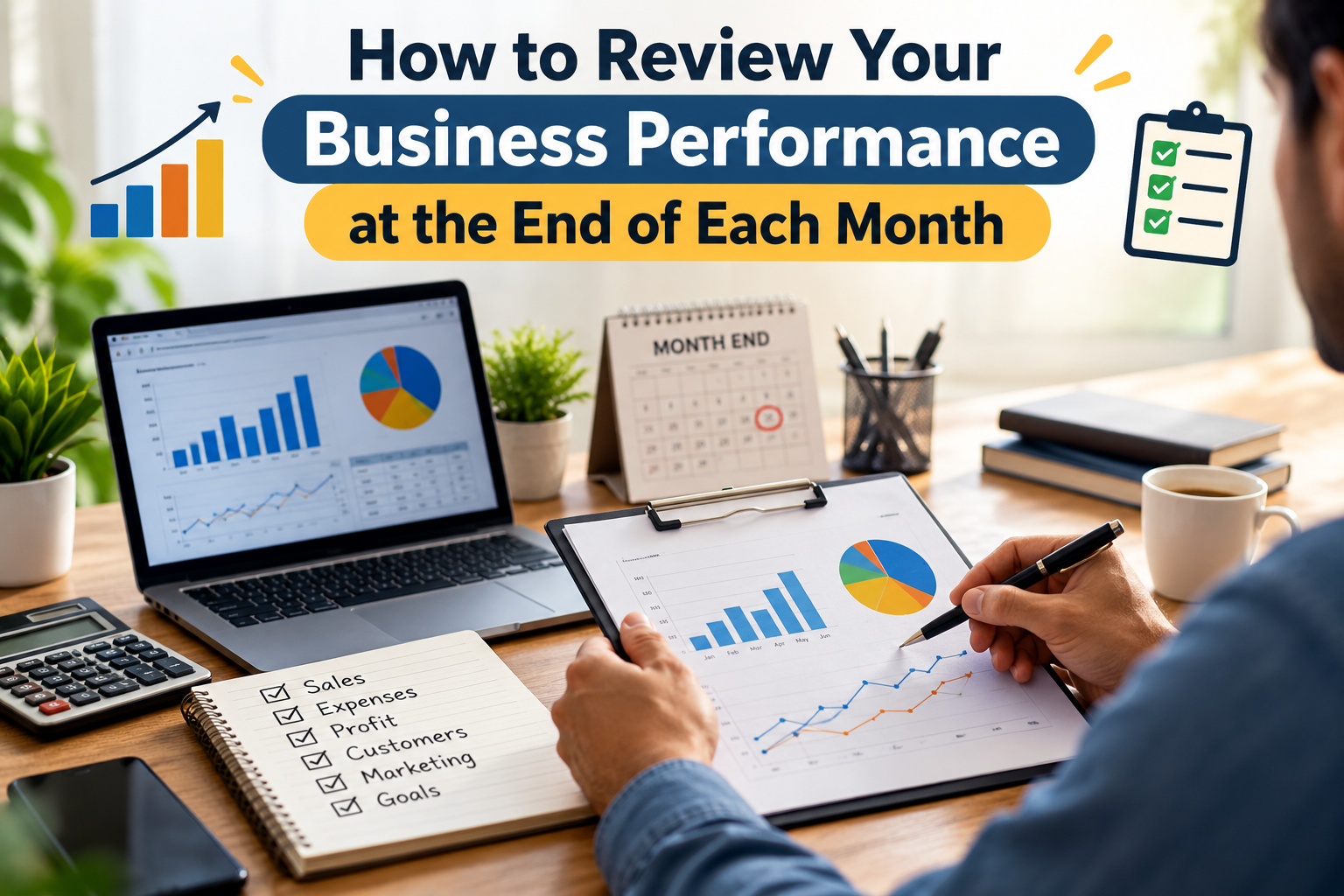
Running a business without reviewing its performance is like driving without checking the road ahead. You may continue moving, but you will not always know whether you are going in the right direction.
A monthly business performance review gives you a clear picture of what is working, what is not working, and what needs improvement. It also helps you make better decisions before small problems become bigger ones.
Many small business owners remain busy with customers, sales, payments, suppliers, marketing, and daily operations. Because of this, they often forget to stop and study their results. I have learned that even a simple monthly review can create more clarity than constantly working without measuring progress.
You do not need complicated software or advanced financial knowledge. You only need the right information, a little time, and a consistent process.
In this guide, I will explain how to review your business performance at the end of each month in a simple and practical way.
Why a Monthly Business Performance Review Is Important
A monthly business performance review helps you understand the real condition of your business.
Daily activities can sometimes create a false feeling of progress. You may receive many orders and stay busy all day, but that does not always mean the business is becoming more profitable.
A proper review allows you to step away from daily work and study the bigger picture.
You can check whether sales are improving, expenses are increasing, customers are returning, and business goals are being achieved.
Monthly reviews are also useful because one month is usually long enough to show meaningful changes but short enough to correct mistakes quickly.
If you wait until the end of the year, you may discover problems that could have been solved much earlier.
Start With Your Monthly Sales
The first area to review is your sales performance.
Look at the total sales generated during the month. Then compare the figure with the previous month.
Ask simple questions.
Did sales increase or decrease?
Which products or services sold the most?
Which products performed poorly?
Were there certain weeks when sales were stronger?
You should also compare your monthly sales with your target if you had one.
For example, if your monthly sales target was $10,000 and actual sales were $8,500, you achieved 85 percent of your target.
This does not automatically mean the month was bad. The important thing is to understand why the target was missed.
Maybe customer demand was lower. Maybe your marketing activity was reduced. Maybe one major customer delayed an order.
The purpose of the review is not to blame yourself. It is to understand what happened.
Review Your Business Expenses
Sales alone do not tell you whether your business is performing well.
You also need to review expenses.
Go through all major business costs for the month, including rent, salaries, advertising, software, utilities, transportation, supplies, packaging, and other operating expenses.
Compare these expenses with previous months.
Look for unusual increases.
For example, if your advertising cost increased by 40 percent but sales increased by only 5 percent, you may need to study whether that extra advertising was worth the money.
You should also separate necessary expenses from optional expenses.
Some costs are required to keep the business running. Others may be reduced or delayed if necessary.
A monthly expense review is one of the easiest ways to find unnecessary spending before it becomes a long term problem.
Calculate Your Monthly Profit
After reviewing sales and expenses, calculate your profit.
In simple terms:
Profit equals total revenue minus total expenses.
For example, if your business earned $15,000 and total expenses were $11,000, your monthly profit was $4,000.
You should compare your profit with previous months.
A business can increase sales but still earn less profit if expenses are growing too quickly.
This is why profit is often more important than sales alone.
It is also useful to calculate your profit margin.
Profit margin shows how much profit you keep from every dollar of sales.
If your business earns $20,000 in revenue and keeps $4,000 as profit, your profit margin is 20 percent.
Tracking this percentage every month helps you understand whether your business is becoming more efficient.
Check Your Cash Flow
Profit and cash flow are not the same thing.
A business can be profitable on paper but still have cash problems.
This can happen when customers have not paid their invoices yet or when the business has large upcoming expenses.
At the end of each month, check how much money entered and left the business.
Look at your bank balance, unpaid customer invoices, supplier payments, upcoming bills, and loan repayments.
Ask whether you have enough cash to cover the next month of operations.
Cash flow problems can create stress even in a growing business.
That is why regular cash flow monitoring should be part of every monthly business performance review.
Study Which Products or Services Performed Best
Not every product or service contributes equally to your business.
At the end of the month, identify your strongest and weakest performers.
Look at sales volume, profit margin, customer demand, and the time required to deliver each product or service.
Sometimes a product may generate high sales but very little profit.
Another product may sell less but provide a much better profit margin.
This type of analysis can help you decide where to focus your time and marketing budget.
You may discover that some products deserve more promotion while others need to be improved, repriced, or removed.
Review Customer Activity
Customers are one of the best sources of information about business performance.
Review how many new customers you gained during the month.
Also check how many existing customers returned to purchase again.
Repeat customers are especially important because they often show that people are satisfied with your products or services.
You can also review customer questions, complaints, reviews, and feedback.
Try to identify repeated patterns.
If several customers complained about slow delivery, this may show that your delivery process needs attention.
If customers regularly praise a particular service, you may have found one of your strongest business advantages.
Customer feedback should not control every decision, but it can help you understand the market more clearly.
Measure Your Marketing Results
Marketing should produce some type of measurable result.
At the end of the month, review each major marketing activity.
This may include social media, email marketing, paid advertisements, search engine traffic, referral campaigns, or local promotions.
Do not only look at likes or followers.
Try to connect marketing with real business results.
Ask how many website visits, inquiries, leads, and sales came from each marketing channel.
You may discover that one channel produces a lot of attention but very few customers.
Another channel may have less traffic but generate stronger sales.
This information helps you spend your marketing budget more wisely.
Review Your Business Goals
Every business should have clear short term and long term goals.
At the end of the month, review the goals you set earlier.
For example, you may have planned to gain 50 new customers, increase monthly sales by 10 percent, reduce expenses, launch a new product, or improve your website.
Check your progress honestly.
Some goals may be completed. Others may still need more work.
If a goal was missed, try to understand the reason.
Maybe the target was unrealistic. Maybe your team lacked enough time. Maybe market conditions changed.
The goal review is not about proving success every month.
It is about learning and adjusting.
Check Productivity and Daily Operations
Business performance is not only about money.
You should also review how efficiently the business operated during the month.
Ask yourself whether tasks were completed on time.
Were there repeated delays?
Did customers wait too long for responses?
Did employees face problems with unclear responsibilities?
Were there unnecessary steps in your daily processes?
Small operational problems can slowly reduce business performance.
A monthly review gives you a chance to notice them.
For example, if employees spend too much time preparing the same reports every week, you may be able to create a simple template or automate part of the process.
Small improvements can save many hours over time.
Review Inventory if You Sell Physical Products
If your business sells physical products, inventory should be reviewed every month.
Check which products are selling quickly and which products are staying in storage for too long.
Too much inventory can tie up your cash.
Too little inventory can cause missed sales.
Try to maintain a balance based on real customer demand.
You should also check for damaged products, missing items, and slow moving stock.
A good inventory review can reduce waste and improve cash flow.
Compare Results With Previous Months
Looking at one month by itself can be misleading.
Try to compare your current results with the last three to six months.
This helps you identify trends.
For example, one month of lower sales may not be a serious issue.
But if sales have been declining for four months, you should investigate the cause.
The same principle applies to expenses, profits, website traffic, customer complaints, and other business numbers.
Trends often provide more useful information than single numbers.
Identify Your Biggest Win of the Month
A monthly review should not focus only on problems.
You should also identify what went well.
Ask yourself what the biggest success of the month was.
Maybe you gained an important new customer.
Maybe a marketing campaign performed better than expected.
Maybe your team improved delivery speed.
Maybe a new product received positive feedback.
Understanding your wins helps you repeat successful actions.
Many business owners move quickly from one month to the next without studying why something worked.
This is a missed opportunity.
Success can also provide useful lessons.
Identify Your Biggest Problem
After reviewing your success, identify the biggest problem that affected the business.
Try to choose one main issue instead of creating a long list.
For example, the biggest problem may be rising costs, delayed customer payments, low website conversions, poor customer retention, or slow operations.
Once you identify the main issue, decide what action you will take next month.
A business improves faster when problems are connected to clear actions.
Create a Simple Monthly Business Report
You do not need a complicated report.
A simple one page summary may be enough.
Your report can include total sales, total expenses, profit, cash balance, new customers, repeat customers, top selling products, marketing results, major achievements, problems, and next month goals.
Keeping these reports every month creates a valuable history of your business.
After one year, you will have twelve reports showing how your business changed over time.
This information can also be useful when speaking with accountants, investors, lenders, or business partners.
Set Priorities for the Next Month
The final part of your monthly business performance review is planning.
Choose three to five important priorities for the coming month.
Avoid creating a huge list of goals.
Too many priorities can make it difficult to focus.
For example, your priorities may be to reduce advertising waste, improve customer response time, follow up unpaid invoices, promote your best selling service, and reduce one major expense.
Clear priorities help you move from analysis to action.
A review has little value if nothing changes afterward.
Keep the Process Simple and Consistent
Your monthly review does not need to be perfect.
Consistency is more important than complexity.
You can schedule one or two hours at the end of every month to review your numbers and write your observations.
Use the same basic format each time.
As your business grows, you can add more detailed measurements.
In the beginning, focus on the most useful information.
A simple system that you actually use is better than a complicated system that you avoid.
Final Thoughts
Learning how to review your business performance at the end of each month can make you a more informed and disciplined business owner.
The process helps you understand your sales, expenses, profit, cash flow, customers, marketing, operations, and overall progress.
More importantly, it gives you a regular opportunity to learn from your business.
Every month contains useful information.
Some months show growth. Some reveal weaknesses. Others teach you which ideas are worth continuing and which ones need to change.
The goal is not to have perfect results every month.
The goal is to understand your business better than you did the month before.
When you create a habit of monthly business performance reviews, decisions become easier because they are based on real information instead of assumptions.
Over time, this simple habit can help you control costs, improve profitability, understand customers, and build a stronger business.
A successful business is not only built through hard work. It is also built by regularly measuring results, learning from experience, and making better decisions for the future.
