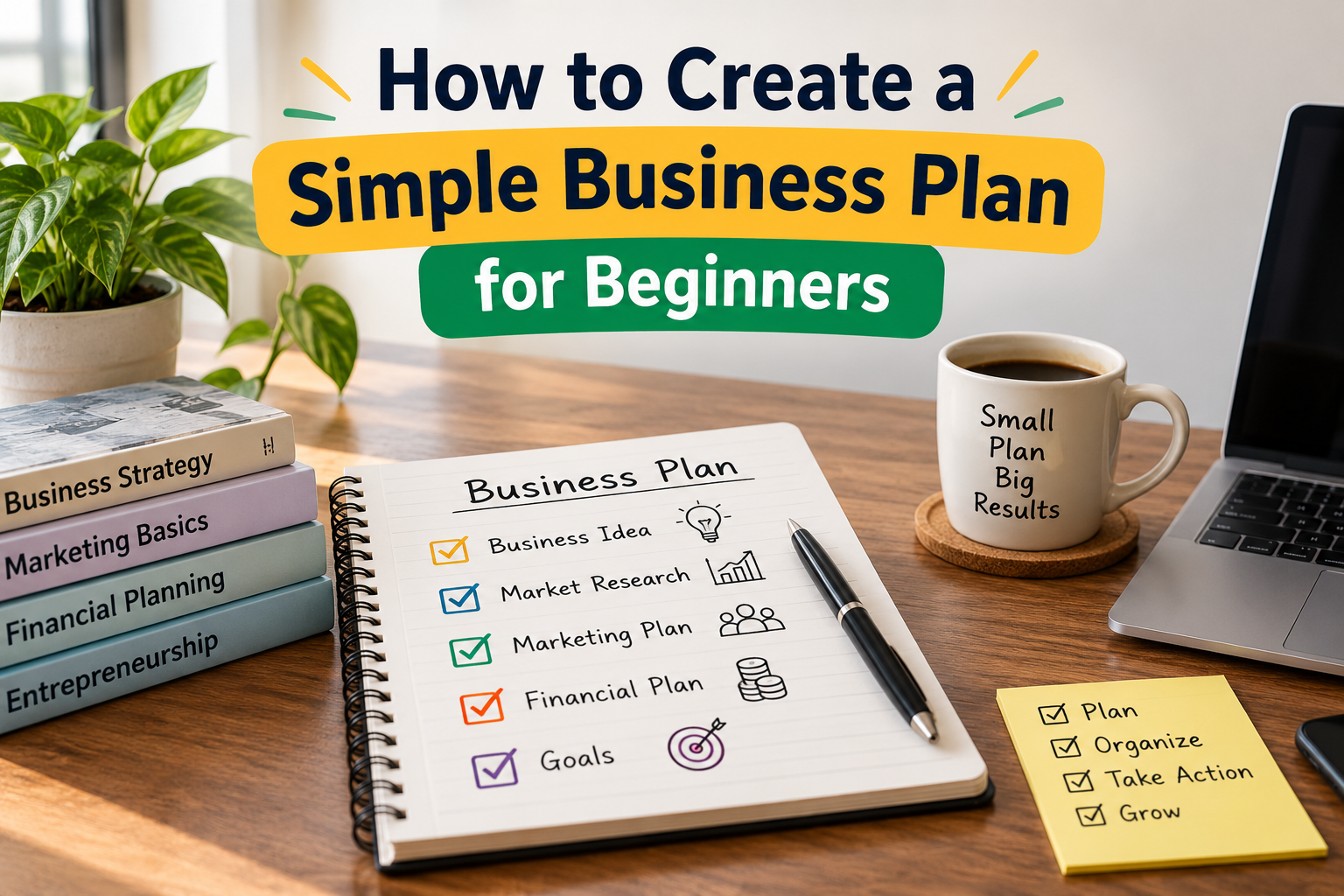
Starting a business can feel exciting, but it can also become confusing when you have many ideas and no clear direction. One of the best ways to organize those ideas is to create a simple business plan.
A business plan does not need to be a long, complicated document filled with technical language. For a beginner, it can be a clear and practical guide that explains what the business will do, who it will serve, how it will make money, and what steps are needed to move forward.
After reading about entrepreneurship, business planning, customer behavior, and small business management, I have realized that a useful business plan is not about making perfect predictions. It is about thinking carefully before investing your time and money.
This guide explains how to create a simple business plan for beginners in a practical and easy way.
What Is a Business Plan?
A business plan is a written document that explains how a business is expected to operate.
It usually includes the business idea, target customers, products or services, marketing approach, financial expectations, and future goals.
Think of a business plan as a map. A map does not guarantee that a journey will be easy, but it helps you understand where you are going and which direction you should take.
A simple business plan can also help you notice problems before they become expensive.
For example, you may discover that your target market is too small, your costs are too high, or your pricing is not realistic.
Finding these problems on paper is usually much easier than discovering them after launching the business.
Why Beginners Need a Business Plan
Many beginners believe that business plans are only required when applying for a bank loan or looking for investors.
That is not true.
Even if you are starting a very small business with your own savings, a business plan can help you make better decisions.
It gives your idea structure.
Instead of simply saying, “I want to start an online store,” you begin asking useful questions.
What will I sell?
Who will buy it?
Why would customers choose my store?
How will customers find me?
How much will the business cost?
How much revenue could it generate?
These questions turn a general idea into a more realistic business concept.
Start With a Simple Business Summary
The first part of your simple business plan should explain the business in a few clear paragraphs.
You do not need complicated business language.
Write what the business will do and what problem it will solve.
For example, imagine you want to start a home cleaning service.
Your summary could explain that the business will provide reliable home cleaning services to busy families and working professionals in your local area.
The purpose of this section is to make your business easy to understand.
Try to include the business name, business idea, main product or service, target customer, and main goal.
If someone reads only this section, they should understand the basic concept of your business.
Describe the Problem You Want to Solve
Most successful businesses solve some kind of problem.
The problem does not always have to be serious.
Sometimes the problem is simply inconvenience.
A coffee shop solves the need for convenient drinks and a comfortable place to sit.
A delivery service saves customers time.
A tutoring business helps students understand difficult subjects.
A clothing store helps customers find products that match their preferences.
When creating a simple business plan for beginners, clearly describe the problem your business is trying to solve.
Ask yourself what frustration, need, desire, or inconvenience your customer experiences.
Understanding the problem makes it easier to design a useful solution.
Explain Your Product or Service
Next, describe exactly what you are planning to offer.
Keep this section simple and specific.
If you are selling products, explain what type of products you will sell.
If you are offering a service, explain how the service works.
Suppose you want to start a social media management business.
Instead of writing that you will provide marketing services, explain that you will help small businesses create social media posts, schedule content, answer customer messages, and improve their online presence.
Specific descriptions make your business plan more realistic.
You should also explain how your product or service is different from existing options.
It does not have to be completely unique.
You may compete through convenience, customer service, quality, location, specialization, price, or a better buying experience.
Identify Your Target Customer
One of the most important parts of a business plan is identifying your target customer.
Trying to sell to everyone usually makes marketing more difficult.
A target customer is the type of person who is most likely to buy your product or service.
Think about characteristics such as age, location, income, occupation, interests, problems, and buying behavior.
For example, a meal preparation service may target busy office workers who want convenient and healthy meals.
A children’s clothing business may focus on parents with young children.
A business selling professional software may target companies rather than individual consumers.
The better you understand your customer, the easier it becomes to create the right product and marketing message.
Research Your Market
A business plan should be based on research, not only assumptions.
You do not need to conduct expensive market studies.
Beginners can learn a great deal through simple research.
Look at existing businesses in your market.
Study their websites, products, prices, customer reviews, social media pages, and marketing methods.
You can also speak with potential customers.
Ask what they currently use, what they like, what they dislike, and what they wish was better.
Search online communities where people discuss problems related to your industry.
The goal is to understand whether real demand exists.
Market research can also reveal opportunities that were not obvious at the beginning.
Study Your Competitors
Competition is normal in business.
In fact, competition can sometimes be a positive sign because it shows that customers are already spending money in that market.
Create a short list of direct competitors.
Study what they sell, how they price their products, how they attract customers, and what customers say about them.
Then ask yourself where your business could provide something different.
Maybe competitors have slow customer service.
Maybe their products are expensive.
Maybe they serve a broad market while you can focus on a specific group.
Your goal should not be to copy competitors.
The purpose of competitor research is to understand the market and find a clear position for your own business.
Decide How Your Business Will Make Money
Every business needs a clear revenue model.
In simple terms, you need to know how customers will pay you.
Some businesses make money by selling physical products.
Others charge for services.
Some businesses use subscriptions where customers pay regularly.
Others earn commissions, advertising revenue, licensing fees, or membership fees.
Write down exactly how your business expects to generate revenue.
If you have multiple revenue sources, list them separately.
This section should be easy to understand.
If you cannot clearly explain how the business will make money, the business model may need more research.
Create a Simple Pricing Strategy
Pricing is another important part of a simple business plan.
Your price should cover your costs while still providing value to customers.
Start by calculating the cost of providing your product or service.
Include materials, packaging, transportation, software, labor, marketing, transaction fees, and other expenses.
Then research what similar businesses charge.
Do not automatically choose the cheapest price.
Low prices can attract customers, but they can also reduce profit and make it difficult to maintain quality.
Think about the value you provide.
Customers often pay more when they believe a product or service is reliable, convenient, high quality, or specialized.
Explain Your Marketing Plan
A good business can struggle if customers do not know it exists.
Your business plan should explain how you will reach potential customers.
There are many possible marketing methods.
You may use social media, search engines, local advertising, content marketing, referrals, email marketing, networking, partnerships, or online marketplaces.
The best marketing channels depend on your target customer.
For example, if you are targeting local homeowners, local search results and community groups may be useful.
If you are targeting younger consumers, social media platforms may play a larger role.
Do not try to use every marketing method at once.
Beginners usually benefit from choosing a few channels and learning how to use them properly.
Write Down Your Startup Costs
Many new businesses fail because owners underestimate how much money they need.
Your simple business plan should include an estimate of startup costs.
Possible expenses may include equipment, inventory, website costs, registration fees, rent, packaging, software, advertising, furniture, transportation, and professional services.
Some businesses can start with very little money.
Others require a larger investment.
Knowing your expected costs helps you decide whether your idea fits your available budget.
It can also show where you can reduce unnecessary spending.
Estimate Monthly Expenses
Startup costs are only part of the financial picture.
You also need to understand your monthly expenses.
These are the costs required to keep the business running.
Examples may include rent, internet, software subscriptions, salaries, fuel, advertising, utilities, delivery costs, and inventory replacement.
Create a realistic estimate.
It is better to be slightly cautious than overly optimistic.
Knowing your monthly expenses helps you understand how much revenue the business needs to survive.
Create a Basic Sales Estimate
Beginners sometimes make the mistake of predicting very high sales without explaining where those customers will come from.
Instead, create a simple and realistic sales estimate.
For example, imagine you provide a service for $50.
If you expect to serve 20 customers per month, your estimated monthly revenue would be $1,000.
Then compare this revenue with your expenses.
You can create several scenarios.
One scenario can represent slower sales.
Another can represent average sales.
A third can represent strong sales.
This approach helps you understand how different levels of demand could affect the business.
Set Clear Business Goals
A business plan should also explain what you want to achieve.
Your goals should be specific enough to measure.
Instead of writing, “I want my business to grow,” create a clearer goal.
For example, you might aim to get your first 20 paying customers within three months.
You might aim to reach a certain monthly revenue level.
You might aim to launch a website, introduce a new service, or expand into another location.
Clear goals help you measure progress.
They also give you something practical to work toward.
Create a Simple Action Plan
Ideas become useful when they are connected to action.
At the end of your business plan, write the main steps required to launch the business.
For example, your action plan might include researching suppliers, choosing a business name, checking legal requirements, creating a website, opening business social media accounts, preparing products, setting prices, and beginning marketing.
Arrange the steps in a logical order.
Then give yourself realistic deadlines.
You do not need to solve everything at once.
Starting with small, manageable tasks can make the business feel much more achievable.
Keep Your Business Plan Flexible
A business plan should not become a document that you write once and never read again.
Business conditions change.
Customer preferences change.
New competitors appear.
Costs increase.
Technology develops.
Your own understanding of the market will also improve.
Review your business plan regularly.
You may discover that certain assumptions were correct while others were wrong.
Updating your plan does not mean you failed.
It means you are learning from real information.
Many successful businesses change direction after discovering what customers actually want.
Avoid Making the Plan Too Complicated
One of the biggest mistakes beginners make is trying to create a perfect business plan before taking any action.
Your first plan does not need to be fifty pages long.
A simple plan of a few pages can be enough to organize your ideas.
Focus on the most important questions.
What am I selling?
Who is my customer?
What problem am I solving?
Why would someone buy from me?
How will customers discover the business?
How much will it cost?
How will the business make money?
What are my first goals?
If you can answer these questions clearly, you already have the foundation of a useful business plan.
Test Your Assumptions Before Spending Too Much
A business plan is based partly on assumptions.
You assume customers will like your offer.
You assume a certain price will work.
You assume a marketing method will attract buyers.
Before investing heavily, test these assumptions.
You might create a basic version of your product.
You might offer the service to a small number of customers.
You might create a simple landing page and measure interest.
You might interview potential customers.
Small tests provide real information.
This information can help you improve your business plan before making larger financial commitments.
Final Thoughts
Learning how to create a simple business plan for beginners is one of the most useful steps you can take before launching a business.
A business plan gives structure to your idea and forces you to think about customers, competition, pricing, marketing, expenses, revenue, and goals.
It does not need to be complicated.
The best beginner business plan is one that you can actually understand and use.
Start with your business idea. Explain the problem you want to solve. Identify your target customer. Research your market. Study competitors. Decide how you will make money. Estimate costs. Create a marketing approach. Set realistic goals. Then turn the plan into practical actions.
A business plan cannot guarantee success, but it can help you make more informed decisions.
Most importantly, remember that planning and action should work together.
Research your idea carefully, write down what you learn, test your assumptions, listen to customers, and keep improving the plan as your business develops.
That simple process can turn an early idea into a much more organized and realistic business opportunity.