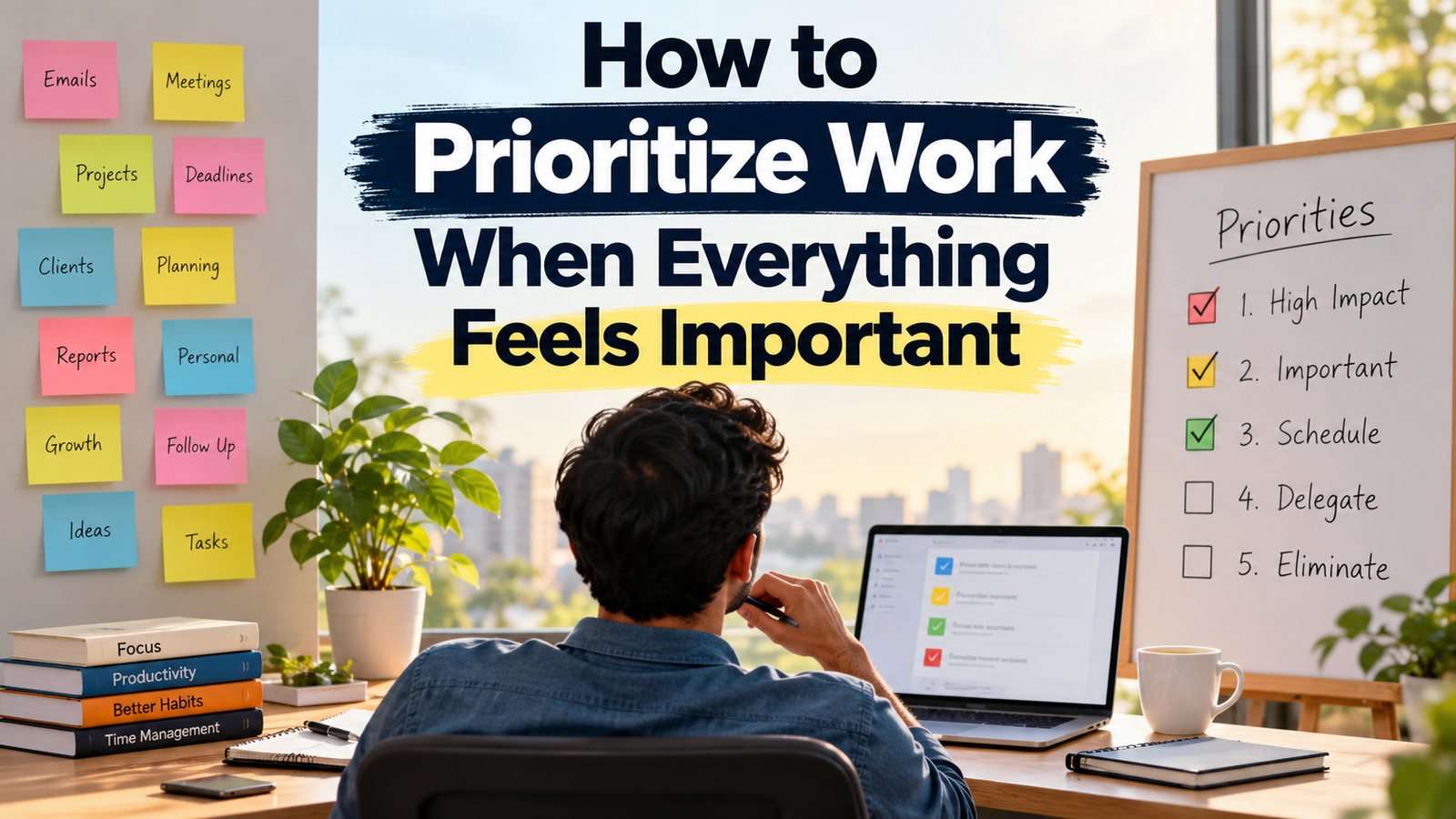
There are days when every task on your list seems urgent. Emails need replies, customers need attention, reports are waiting, meetings are scheduled, and unfinished work keeps building up. When everything feels important, deciding what to do first can become more difficult than doing the work itself.
I have noticed that poor prioritization does not always come from laziness or lack of effort. In many cases, people are working very hard. The real problem is that they are giving equal attention to tasks that do not have equal value.
Learning how to prioritize work is one of the most useful skills for anyone running a business, managing a team, studying, or handling a busy professional life. Good prioritization helps you protect your time, reduce stress, and focus your energy on the work that creates the most meaningful results.
The goal is not to finish everything at once. The goal is to identify what deserves attention now, what can wait, and what may not need to be done at all.
Why Everything Can Feel Important
When several responsibilities arrive at the same time, the brain can start treating all of them as urgent. A message from a customer may feel just as important as a long term business decision. A small administrative task can feel as serious as a deadline that affects revenue.
This happens because unfinished tasks create mental pressure.
Every open task occupies a small amount of attention. When there are too many open tasks, it becomes harder to think clearly. Instead of calmly evaluating priorities, we may start reacting to whatever appears in front of us.
This is one reason people spend an hour answering messages while avoiding a project that could have a much larger impact.
The first step in learning how to prioritize work is understanding that urgency and importance are not the same thing.
Understand the Difference Between Urgent and Important Work
Urgent tasks demand attention quickly.
Important tasks contribute to meaningful goals.
Sometimes a task is both urgent and important. A customer issue that may cause a major loss is a good example.
Sometimes a task is urgent but not very important. A routine request that someone wants immediately may fall into this category.
Some important tasks are not urgent at all. Business planning, employee development, customer research, process improvement, and skill building often fit here.
These important but non urgent activities are easy to postpone because there is no immediate pressure. However, they often create the greatest long term value.
When deciding what to do first, ask two simple questions.
Does this task require attention soon?
Does this task significantly affect an important goal?
These questions can immediately create more clarity.
Start With Your Most Important Goals
It is difficult to prioritize daily work if you are not clear about your larger goals.
Imagine that your business has three main goals for the next six months.
Increase sales.
Improve customer retention.
Reduce unnecessary operating costs.
Now every task can be compared with these goals.
A task that directly contributes to one of these areas deserves more attention than a task that has little connection with them.
This does not mean small administrative tasks are useless. They still need to be completed. However, they should not automatically receive your best working hours.
Your goals act as a filter.
Without that filter, every request can feel equally important.
With it, you can ask a much better question.
Which task moves me closer to an important result?
That question is at the heart of effective work prioritization.
Make One Complete Task List
When tasks are scattered across notebooks, emails, messages, and memory, prioritization becomes much harder.
Create one main task list.
Write down everything that needs attention.
Do not try to organize it immediately. First, clear your mind by putting all your responsibilities in one place.
Your list may include customer calls, reports, payments, planning, marketing, meetings, research, personal responsibilities, and small administrative duties.
Once everything is visible, you can begin comparing tasks properly.
A complete list also reduces the fear that you may forget something.
Instead of repeatedly thinking about unfinished work, you can trust the list and focus on one task at a time.
Identify Tasks With Real Consequences
One useful way to prioritize work is to think about consequences.
Ask yourself what will happen if a task is delayed.
If nothing meaningful happens, the task probably does not belong at the top of your list.
If delaying it may create financial loss, customer dissatisfaction, a missed deadline, legal trouble, or a serious operational problem, then it deserves more attention.
For example, imagine you have these four tasks.
Reply to a general information email.
Prepare a proposal due tomorrow.
Rearrange files on your computer.
Review a payment issue affecting a supplier.
All four tasks may feel important.
However, their consequences are very different.
The proposal and payment issue probably deserve attention before reorganizing files.
Thinking about consequences helps separate real priorities from tasks that simply feel uncomfortable to leave unfinished.
Focus on Impact Instead of Activity
Busy people often measure productivity by activity.
They answer many messages, attend meetings, update documents, and complete small tasks.
At the end of the day, they may feel exhausted but still wonder what they actually achieved.
A better approach is to measure work by impact.
Ask which tasks create the most useful result.
Suppose you run a small business and have two options.
Spend two hours improving a sales proposal that could lead to a major client.
Spend two hours adjusting minor details on an internal spreadsheet.
Both are work.
Both may be necessary.
But they do not have the same impact.
Prioritizing high impact work does not mean ignoring routine tasks. It means giving your best attention to the tasks that matter most.
Choose Your Top Three Priorities
Long task lists can create unnecessary pressure.
One method that works well is selecting three main priorities for the day.
These are the tasks that would make the day productive even if several smaller tasks remain unfinished.
Your top three might include completing a customer proposal, reviewing monthly expenses, and preparing for an important meeting.
After these priorities are clear, smaller tasks can be fitted around them.
This approach creates focus.
Instead of asking, “How can I finish fifteen tasks today?” you start asking, “Which three tasks matter most?”
That small change can make workload feel much more manageable.
Consider Deadlines Carefully
Deadlines are an important part of prioritization, but they should not be the only factor.
A task due today usually deserves more attention than one due next month. However, a large project due next month may need to start today if it requires several weeks of work.
This is where many people get into trouble.
They wait until an important project becomes urgent.
A better approach is to look at both the deadline and the amount of work required.
If a task takes ten hours and is due in five days, you should not treat it as a task that can wait four days.
Breaking large projects into smaller steps helps prevent last minute pressure.
Estimate the Value of Each Task
Not every task produces the same value.
Some tasks generate revenue.
Some reduce risk.
Some improve customer relationships.
Some save future time.
Others simply maintain basic operations.
When everything feels important, ask what type of value each task creates.
For example, talking to a potential customer may create future income.
Improving a repeated business process may save several hours every month.
Checking a routine document for the fifth time may create very little additional value.
Understanding task value helps you decide where your time should go.
Do Difficult Important Work When Your Energy Is High
Time management is not only about hours. It is also about energy.
Most people have certain periods when they can think more clearly.
For some, this is early morning. For others, it may be afternoon or evening.
Use your strongest mental hours for important work that requires concentration.
Do not automatically spend your best energy answering routine emails.
If you have a complex report, business strategy, financial review, or important writing task, schedule it when your mind is fresh.
Routine tasks can often be handled later.
Protecting your high energy hours is one of the simplest ways to improve productivity.
Stop Treating Every Request as an Emergency
Other people may describe their requests as urgent.
That does not always mean they are your highest priority.
Before immediately changing your schedule, ask what the request actually requires and what happens if it waits.
This is especially important in business environments where messages arrive throughout the day.
Constantly switching tasks can destroy concentration.
Every interruption forces your brain to leave one subject and enter another.
Over time, this creates mental fatigue.
Whenever possible, finish important focused work before responding to lower priority interruptions.
Group Similar Tasks Together
Task switching wastes time.
If you reply to one email, then review a report, then make a phone call, then return to email, your brain is constantly changing direction.
Grouping similar tasks can make work more efficient.
You might answer emails at two or three planned times during the day.
You can make several phone calls during one block.
You can review documents together.
You can handle invoices in one session.
This method reduces mental switching and makes routine work easier to control.
It also prevents small tasks from spreading across your entire day.
Learn to Delegate
Sometimes everything feels important because you are personally carrying too many responsibilities.
Delegation can solve part of this problem.
Ask whether every task truly requires your involvement.
A task may be important without needing to be completed by you.
If another team member can handle routine reporting, scheduling, data entry, follow up calls, or basic customer requests, delegation may free your time for higher value work.
Good delegation requires clear instructions and reasonable follow up.
The purpose is not simply to move work away from yourself. The purpose is to make better use of everyone’s time and abilities.
Remove Tasks That Do Not Need to Be Done
One of the most overlooked productivity strategies is elimination.
Some tasks remain on lists because they have always been there.
Ask whether the task still serves a useful purpose.
Does this report need to be created every week?
Does this meeting need to happen?
Does this document require another review?
Does this process still make sense?
Removing unnecessary work creates more time than almost any productivity technique.
Sometimes the best way to prioritize a task is to decide that it no longer deserves a place on the list.
Use Time Blocks for Important Work
A priority without scheduled time can easily be replaced by something else.
If a task is genuinely important, give it a place on your calendar.
For example, you might schedule 9:00 AM to 10:30 AM for a proposal.
You may reserve 2:00 PM to 3:00 PM for financial review.
This makes priorities more concrete.
Time blocking also protects important work from endless minor requests.
You do not need to schedule every minute of the day. Leave some space for unexpected issues.
The purpose is simply to make sure that your most important work has protected time.
Avoid Perfectionism
Perfectionism can make prioritization harder.
A person may spend too much time improving one task while several more valuable tasks remain unfinished.
Not every task needs your highest level of effort.
Some work requires excellent quality.
Some only needs to be accurate and complete.
Knowing the difference is important.
For example, a major client proposal may deserve several rounds of review.
An internal routine note may not.
Try to match the amount of effort with the importance of the task.
This can save a large amount of time.
Review Your Priorities During the Day
Priorities can change.
A customer emergency may appear.
A deadline may move.
A project may be delayed.
A new opportunity may become more important than something you planned earlier.
This is why it can be useful to review your priorities once or twice during the day.
Do not constantly change your list every few minutes.
Instead, pause at a reasonable time and ask whether your original top priorities still make sense.
Good prioritization requires both discipline and flexibility.
Plan Tomorrow Before Ending Today
One habit I find very useful is preparing the next day’s priorities before finishing work.
Take a few minutes to review unfinished tasks and choose what deserves attention tomorrow.
This gives you a clear starting point.
Instead of beginning the next morning by reading messages and reacting to other people’s demands, you already know what matters.
A simple daily planning routine can reduce decision fatigue and make mornings more productive.
Accept That Some Work Will Remain Unfinished
One of the hardest lessons in productivity is accepting that there will almost always be more work available than time.
The goal is not to reach a permanently empty task list.
The goal is to make sure the most important work receives enough attention.
A productive day may still end with unfinished tasks.
That does not mean you failed.
If you completed the work that had the greatest value, protected important deadlines, and avoided wasting too much time on low impact activity, you probably used your day well.
A Simple Method for Prioritizing Work
When you feel overwhelmed, use this simple process.
First, write down every task.
Second, identify the tasks with serious deadlines or consequences.
Third, connect tasks with your larger goals.
Fourth, look for high impact activities.
Fifth, choose your top three priorities.
Sixth, schedule focused time for them.
Seventh, delegate or remove lower value work where possible.
Finally, review your priorities as circumstances change.
This method is simple enough to use every day.
You do not need a complicated productivity system to make better decisions. You mainly need a clear way to compare tasks.
Final Thoughts
Learning how to prioritize work when everything feels important is really about learning to make choices.
Time is limited, attention is limited, and energy is limited.
Because of this, every task cannot receive the same level of attention.
Strong prioritization begins with understanding your goals, recognizing real consequences, focusing on high impact work, and protecting time for the responsibilities that matter most.
It also requires the confidence to delay, delegate, or remove lower value tasks.
When everything feels urgent, avoid reacting immediately.
Look at your responsibilities carefully.
Ask what creates the greatest result, what has the most serious consequence, and what truly deserves your attention today.
You may still have a long task list, but you will have something even more useful.
You will have clarity.