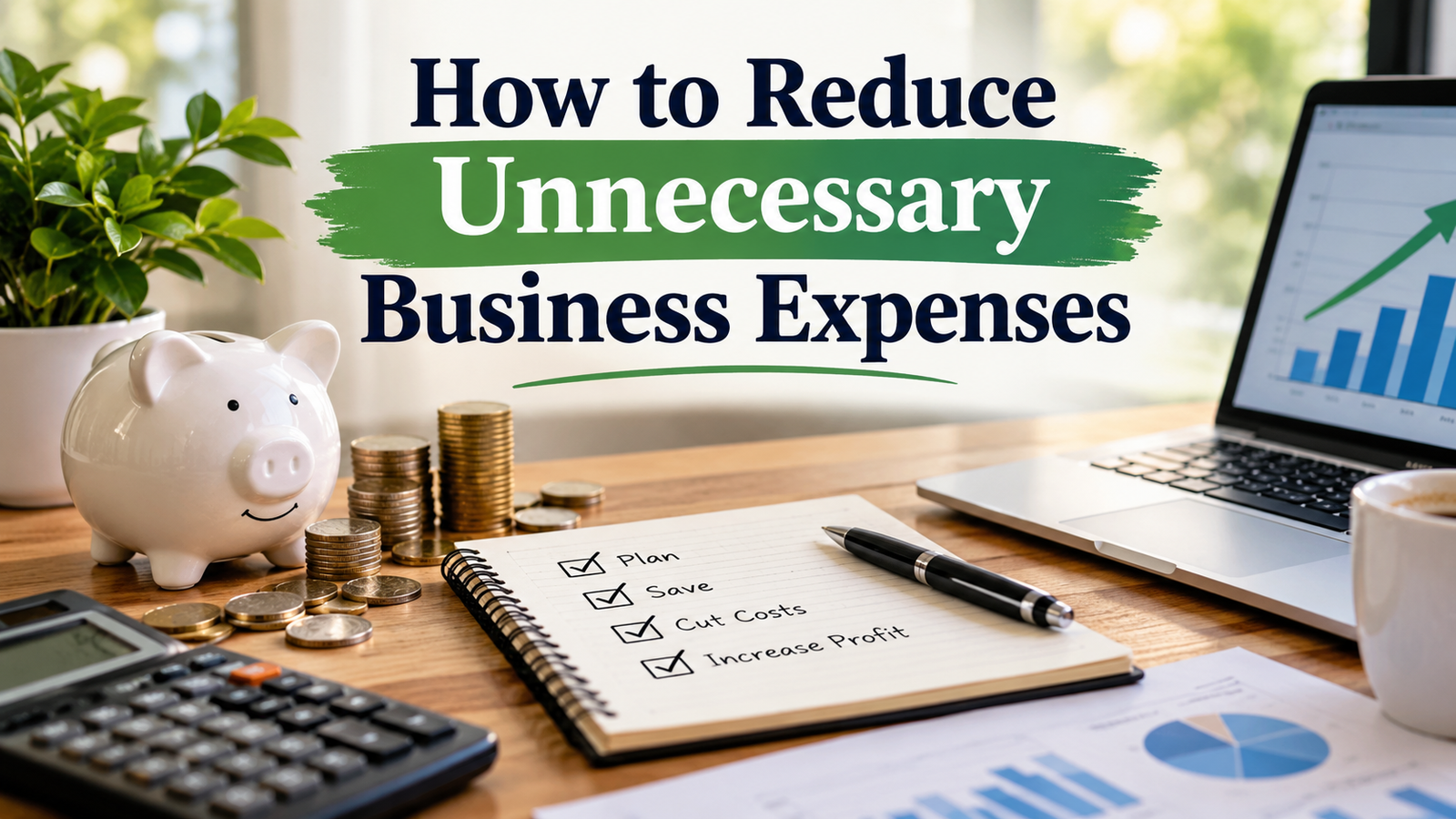
Running a business requires money, but spending money wisely is just as important as earning it. Many businesses struggle not because they have no customers, but because their expenses slowly increase without proper control. Small costs can appear harmless at first, yet when they continue every month, they can reduce profit and create financial pressure.
Learning how to reduce unnecessary business expenses can help a company become stronger, more efficient, and more prepared for the future. The goal is not to stop spending completely. A business needs to spend money on employees, tools, marketing, technology, supplies, and many other areas. The real goal is to understand which expenses support growth and which expenses can be reduced without damaging the quality of the business.
I have found that the best approach is to review expenses regularly instead of waiting until the business faces a financial problem. When spending is monitored carefully, it becomes much easier to identify waste and make better decisions.
Understand Where Your Money Is Going
The first step in reducing unnecessary business expenses is understanding exactly where the money goes.
Many business owners know their major expenses, such as rent, salaries, and inventory, but they may not pay close attention to smaller recurring costs. These can include software subscriptions, delivery charges, bank fees, advertising costs, office supplies, internet packages, maintenance expenses, and other services.
Start by reviewing your business expenses from the last three to six months. Divide them into categories so you can clearly see how much you are spending in each area.
You may separate expenses into categories such as office costs, employee costs, marketing, software, transportation, inventory, utilities, professional services, and equipment.
Once everything is organized, patterns become easier to identify. You may discover that you are paying for several services that perform similar functions, or that certain monthly expenses are no longer necessary.
Good expense management begins with clear information.
Separate Essential Expenses From Optional Expenses
Not every business expense has the same importance.
Some expenses are essential because the business cannot operate properly without them. Others are useful but not necessary. There may also be expenses that provide very little value.
For example, electricity, internet access, employee salaries, important software, and necessary inventory may be essential expenses.
Premium software features, expensive office decorations, unused subscriptions, frequent business meals, or unnecessary upgrades may be optional expenses.
When reviewing your spending, ask a simple question.
Does this expense directly help the business operate, serve customers, increase sales, or protect long term growth?
If the answer is no, the expense deserves closer attention.
This does not mean every optional expense should immediately be removed. Some optional expenses can improve productivity or employee satisfaction. The purpose is to understand the value you receive from each expense.
Cancel Subscriptions You No Longer Use
Subscriptions are one of the easiest areas where unnecessary business expenses can grow.
Modern businesses often use many online tools for accounting, communication, project management, design, marketing, cloud storage, video meetings, and customer management.
Each subscription may seem inexpensive, but several monthly subscriptions can become a significant annual expense.
Review every subscription your business is paying for. Check whether employees are actually using the service and whether the tool still provides enough value.
You may discover that your business is paying for software that has not been used for months.
You may also find that two different tools provide almost the same features.
Cancelling unused subscriptions is a simple way to reduce business costs without affecting daily operations.
It is also useful to review subscriptions every few months because business needs change over time.
Compare Suppliers and Negotiate Better Prices
Businesses often continue working with the same suppliers for many years. This can be convenient, but it may also mean that better prices are available elsewhere.
Regularly compare prices from different suppliers for products, materials, packaging, transportation, and professional services.
You do not always need to change suppliers. Sometimes simply knowing the market price gives you a better position when negotiating.
If you have been buying regularly from the same supplier, ask whether they can offer a volume discount, better payment terms, or reduced delivery costs.
Suppliers often value reliable long term customers and may be willing to provide better conditions.
However, price should not be the only consideration. Reliability, product quality, delivery speed, and customer service are also important.
The goal is to achieve better overall value rather than simply choosing the cheapest option.
Reduce Office Related Costs
Office expenses can quietly increase over time.
Businesses may spend money on electricity, printing, stationery, furniture, cleaning, refreshments, maintenance, and other daily items.
Small changes can reduce these costs.
For example, using digital documents instead of printing everything can reduce paper and printer expenses. Turning off unnecessary lights and equipment can lower electricity bills. Buying office supplies in reasonable quantities can also reduce costs.
If employees can work effectively from home for part of the week, some businesses may even reduce office space requirements.
However, every business is different. A retail store, factory, restaurant, or medical office may need a physical location every day.
The important point is to review how office resources are being used and avoid paying for space, equipment, or supplies that provide little value.
Use Technology to Improve Efficiency
Technology can sometimes increase expenses, but the right technology can also reduce costs.
Automation can save time on repetitive tasks such as invoicing, scheduling, inventory tracking, customer communication, and reporting.
If employees spend many hours performing tasks that software can complete more efficiently, automation may reduce long term operating costs.
However, technology should be selected carefully.
Buying expensive software simply because it has many features is not always a good decision. The best tool is usually the one that solves a real business problem.
Before purchasing new software, identify the exact problem you want to solve. Then compare different options and choose a solution that fits your actual needs.
Using technology wisely can improve productivity while keeping costs under control.
Review Marketing Expenses Carefully
Marketing is important for business growth, but marketing money should be spent with a clear purpose.
Many businesses continue paying for advertising simply because they have always used the same platform or strategy.
Instead, track the results of your marketing activities.
For example, if you are spending money on online advertisements, monitor how many visitors, inquiries, leads, or sales are generated.
If one marketing channel produces strong results while another produces very little, you can adjust your spending.
This does not mean stopping marketing whenever immediate sales are low. Some marketing activities build awareness over time.
The important thing is to understand what each campaign is trying to achieve and measure whether it is moving the business toward that goal.
Reducing ineffective marketing expenses can free money for strategies that provide better results.
Avoid Buying Equipment Before It Is Needed
New equipment can be exciting, especially when it promises better performance or productivity.
However, buying equipment too early can create unnecessary financial pressure.
Before purchasing expensive machinery, computers, vehicles, or office equipment, consider how often the business will actually use it.
In some situations, renting or leasing may be more practical.
For example, if specialized equipment will only be needed for a short project, renting may cost less than purchasing and maintaining it.
The same idea applies to technology.
Employees may not need the most expensive computers or smartphones if less expensive models can perform the required tasks effectively.
Business purchases should be based on practical needs rather than appearance or status.
Manage Inventory More Carefully
For businesses that sell physical products, inventory can represent a large amount of money.
Buying too much inventory can create several problems.
Products may remain unsold for months, storage costs may increase, and certain items may become outdated or damaged.
On the other hand, keeping too little inventory can result in lost sales.
The solution is better inventory management.
Track which products sell quickly and which products remain on shelves for long periods.
Use sales history to make better purchasing decisions.
Instead of buying large quantities simply because a supplier offers a discount, consider whether the business can realistically sell those products.
A discount is not really a saving if the products never sell.
Reduce Unnecessary Meetings
Time is also a business expense.
Employees who spend hours in unnecessary meetings are not able to focus on productive work during that time.
Before scheduling a meeting, ask whether the issue could be handled through a short message, email, or shared document.
When meetings are necessary, keep them focused.
Create a clear purpose and discuss only the topics that require attention.
Shorter and more effective meetings can improve productivity and reduce wasted working hours.
This may not appear as a direct expense on a bank statement, but employee time has real financial value.
Control Business Travel and Entertainment Costs
Travel can be necessary for meetings, conferences, training, or customer relationships. However, travel expenses can quickly become expensive.
Flights, hotels, meals, transportation, and other costs can add up.
Before approving business travel, consider whether the same objective can be achieved through a video meeting.
When travel is necessary, booking early can often reduce transportation and hotel costs.
Businesses can also create clear travel policies so employees understand reasonable spending limits.
The goal is not to eliminate valuable face to face meetings. It is simply to make sure that travel expenses are connected to meaningful business objectives.
Prevent Waste Through Better Employee Training
Poor training can create hidden costs.
Employees who do not understand procedures may make mistakes, waste materials, provide incorrect information to customers, or use equipment improperly.
These mistakes can become expensive.
Proper training helps employees understand how to perform their jobs efficiently.
It can also reduce customer complaints, product waste, workplace errors, and unnecessary repetition of tasks.
Training should therefore be viewed as an investment rather than only an expense.
When people know what they are doing, the business usually operates more efficiently.
Review Banking and Payment Fees
Financial fees can easily be overlooked.
Businesses may pay bank charges, payment processing fees, transaction fees, transfer costs, or account maintenance charges.
Individually, these fees may seem small. Over an entire year, they can become significant.
Review your business banking services and payment providers regularly.
Compare transaction fees and account costs from different providers.
If your business processes many payments, even a small difference in transaction fees can have a noticeable effect on annual expenses.
You may also be able to negotiate better rates as your transaction volume increases.
Maintain Equipment Instead of Replacing It Early
Regular maintenance can prevent expensive repairs and replacements.
Vehicles, computers, machinery, air conditioning systems, and other business equipment often last longer when they are properly maintained.
Ignoring small problems can lead to larger problems later.
Create a simple maintenance schedule for important business equipment.
Regular inspections, cleaning, updates, and small repairs may help avoid major expenses.
At the same time, businesses should know when replacement makes more financial sense than continued repair.
The goal is to extend the useful life of equipment without spending excessive money maintaining outdated systems.
Encourage Employees to Suggest Savings
Employees often see waste that business owners or managers do not notice.
They work with equipment, customers, suppliers, and internal processes every day.
Ask employees whether they see opportunities to reduce waste or improve efficiency.
They may identify unnecessary paperwork, repeated tasks, unused tools, excessive material use, or inefficient processes.
Creating a workplace culture where employees are encouraged to suggest improvements can lead to significant savings over time.
Employees should understand that cost control is not only about reducing budgets. It is about using resources more intelligently.
Create a Monthly Expense Review
Reducing business expenses should not be a one time project.
Business conditions change constantly.
New subscriptions are added, supplier prices change, employees join, equipment is purchased, and marketing campaigns begin.
A monthly expense review helps prevent spending from becoming uncontrolled.
Choose a specific time each month to review major expenses.
Compare current spending with previous months.
If an expense suddenly increases, investigate the reason.
You can also compare expenses with revenue to understand whether costs are growing faster than the business.
Regular reviews make financial problems easier to identify before they become serious.
Do Not Cut Costs That Support Growth
One of the biggest mistakes businesses can make is reducing the wrong expenses.
Cost cutting should never damage customer service, product quality, employee safety, or important business operations.
For example, purchasing lower quality materials may reduce costs temporarily but could create more customer complaints.
Reducing employee training may save money today but increase mistakes later.
Stopping effective marketing may reduce expenses but also reduce future sales.
The purpose of cost reduction is to remove waste, not remove value.
Every expense should be evaluated based on both its cost and its contribution to the business.
Build a Cost Conscious Business Culture
Expense management becomes easier when everyone in the organization understands its importance.
Managers and employees should treat business resources carefully.
Simple habits can make a difference.
Employees can avoid unnecessary printing, protect equipment, manage supplies responsibly, reduce waste, and report inefficient processes.
Business owners should also lead by example.
If management spends carelessly, employees may not take expense control seriously.
A cost conscious culture does not mean creating an uncomfortable workplace. It simply means respecting the company’s resources.
Final Thoughts
Understanding how to reduce unnecessary business expenses is one of the most valuable skills a business owner can develop.
Successful cost management does not require cutting every expense. It requires understanding where money is being spent and deciding whether each expense provides enough value.
Start by reviewing your financial records, subscriptions, suppliers, office costs, marketing expenses, inventory, equipment, and banking fees. Look for areas where money is being spent without producing meaningful results.
Small improvements can create significant savings when they continue month after month.
Most importantly, avoid reducing expenses that directly support customers, employees, product quality, or long term growth.
A healthy business is not simply a business that spends less. It is a business that spends wisely.
By building regular expense reviews into your business routine, you can protect cash flow, improve profitability, and create a stronger financial foundation for future growth.